
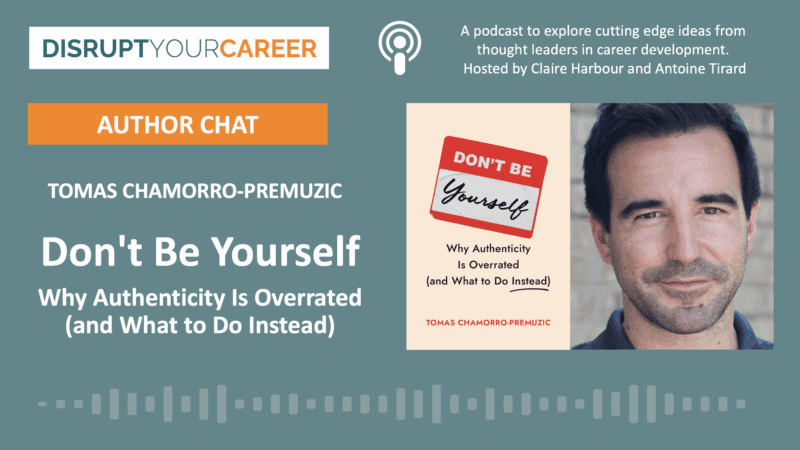
Author Chat: Don’t Be Yourself by Tomas Chamorro-Premuzic
How often have we been told that success, especially in leadership, starts with “just being yourself”? In his latest book, Don’t Be Yourself: Why Authenticity Is Overrated (and What to Do Instead), renowned psychologist Tomas Chamorro-Premuzic challenges this deeply rooted belief. Drawing on decades of research, he argues that our cultural obsession with authenticity is often misguided and can actually limit individual and organizational effectiveness. The science, he suggests, points to a more nuanced truth: progress comes from adaptability, self-awareness, and attention to how others experience us.
In this edition of Disrupt Your Career Author Chat, we speak with Tomas about his book, exploring why authenticity is misunderstood, how leaders really develop, and what it takes to evolve beyond our current selves in today’s complex workplaces. An edited version of our conversation with Tomas follows.
Tomas, thank you for being with us again. To start with a simple question: what led you to write this book?
The pattern over the past 10, 15 years with this more general audience book has always been the same. I get obsessed, if not fixated by topics where the mainstream view has become so absurd, so ridiculous, that a scientific or evidence, and even commonsensical perspective on the topic is heretic. And that is definitely the case with authenticity. We hear over and over again: if you want to be a great leader, all you have to do is to stop worrying about what people think of you, to just be you. We keep on seeing companies or organizations encouraging young people to bring their whole self to work or even to a job interview. All of this is at odds with the science of effective interpersonal functioning. So my goal and my wish, my aspiration here, I might be naive, but it’s to close the gap between science and popular views, which actually influence HR and leadership practices around authenticity.
You do so many things in so many different places, so how did you find the time and space to write this book?
My day has 24 hours, just like anybody else’s. A lot of people tell me, “Well, you’re so prolific, so productive”, which it’s a nice thing to hear – it’s a nice compliment. For me, it’s quite surprising because I’m actually very disorganized. I never plan. I’m lucky to have various teams that are very good and whom I work with and they’re full of talented people. When you can delegate, you focus on thinking big picture, long term strategy and make focus and really prioritizing on what decisions are important, then a lot of the execution part should be delegated to talented people in your teams, and that’s what I do. Now, the writing specifically comes in bursts. I would say, bursts of energy or enthusiasm. To give you an example, I like to swim in the mornings. I go for a swim and as I’m swimming, because I can’t be connected, ideas come. Then I might do 40 minutes of swimming, and as soon as I get back home, I write 15 pages, and that just takes maybe 10, 15 minutes. Then you leave it for editing on a long flight or on a weekend. So even short books like Don’t Be Yourself, which is about 250 pages or so, it sounds quite easy, but from the beginning to the end, it’s a three-and-a-half year process.
What are the key messages and concepts from the book that will make our listeners want to read it?
I guess one key message is that everybody loves authenticity, but not many people understand it. The second one is that it is quite helpful to first acknowledge that you cannot measure in any clear-cut or objective way how authentic somebody is. For example, I might have an idea of how authentic I am right now or how authentic you are. But luckily, we don’t have Neuralink or something in our brains that tells somebody else, “Oh, Claire is now smiling, but she doesn’t actually mean it. She’s being fake, right?” So there is no objective measure, which makes managing it, developing it, or selecting leaders on it quite hard. And then on a practical level, actually, the literature and the science splits into two camps. The camp that evaluates subjective authenticity, how authentic I feel, for example, when I’m doing a job? If I feel more authentic, that’s good because I’ll be happier, more engaged, et cetera. But it doesn’t mean I’m actually better at the job or does other people enjoy working with to me. And the other one which matters a lot more is how authentic you are in the eyes of others. That one is critical.
Everybody loves leaders who seem authentic. Trump voters find Donald Trump authentic and Obama inauthentic. Obama voters find Obama authentic, but Trump inauthentic. The point is that every leader and every professional who is in a senior position of power and responsibility has learned to act authenticity, because their professional self, and you will know this because you’re an executive coach, their professional self seems actually very genuine and trustworthy. That doesn’t mean that anything goes and that they can indulge in imposing their unfiltered or uncensored self on others, which doesn’t end up well.
The second part teaches people how to find the balance between understanding that, on the one hand, their right to express themselves shouldn’t override their obligation to others, and how they can navigate this intricate and delicate tension between one thing to express who they think they are and the parts of themselves which they are proud of, but also exercising empathy and caring about others. So in essence, it’s actually a very commonsensical book. When people hear this, they’re like, “There’s not much controversial in that”, but what’s controversial is what people keep on repeating and believing about the authenticity cult.
Can you share a few stories that show what happens when leaders get authenticity right — and what happens when they don’t?
I’m trained as a Freudian psychoanalyst: you look at how things go wrong, then you can reverse engineer it and find a way to do it right. So I’ll pick a couple, rather than specific case studies – Mary or John, we’re doing this a lot, or Trump or Obama – I’m going to generalize to something that is very applicable to a lot of leaders.
The first is one of the main mantras underpinning the authenticity cult is this notion that you should always, as a leader, be true to your values. Basically, follow your heart no matter what and never compromise when it comes to your values. Well, actually, as I show in the book, it really depends on what your values are. Should you follow your values if… I don’t know, if you’re a fascist? Probably not. If you’re a communist, maybe not either. What if you’re a sexist? What if you’re a racist? What if you’re a narcissist? Then you have egotistical values. And by the way, there’s a lot of more common examples of people who fulfill these values. So you should follow your values if those values are prosocial. If not, society and organizations in your team is better off if you actually learn to put them aside and act in a prosocial way.
Then, as I show in the book, as a leader, your job is to bring people together, not divide. So oftentimes, even if your values seem okay and are good, if you’re proudly expressing them and you’re desperate to say your views on the Middle East, conflicts, climate change, guns, abortion, politics, etc. You might alienate others. The world is already quite tribal and polarized because we seem to have this cult-like approach to, I’m a leader and I’m going to be true to my values, and if you don’t follow me, you’re not part of the cult. That’s a very immature take on leadership.
if you could leave our listeners with one piece of advice to help them lead with authenticity and balance, what would it be?
As I say in my book, authenticity research and work is mostly all footnotes to my dear friend, Herminia Ibarra, and I steal proudly from her, and I obviously acknowledge her pioneering work here. But for me, the most beautiful counterintuitive but impactful leadership advice or hack that comes from this work, this book, and largely her research, is as simple as that: Why limit yourself to your past and present self, which is basically your authentic self, who you naturally are and what comes easily to you and what’s in your comfort zone, where you could actually sculpt, create, or design a future self that contains elements of you that haven’t been expressed? In essence, leaders are always a work in progress, and the only way to evolve or develop as a leader is to not be bounded or constrained by your current and past self, but create new versions of you. So that might be the most poetic, romantic, but also important lesson to not just be yourself.
We are indeed all ‘work in progress’. Thank you, Tomas.
To listen to this Author Chat podcast episode
Order Tomas‘book Don’t Be Yourself: Why Authenticity Is Overrated (and What to Do Instead)
Tomas’ personal website
Tomas’ LinkedIn profile
Sign up
Sign up to receive regular insightful news and advice on managing your career and receive a free gift. Inspiration delivered straight to your Inbox!