
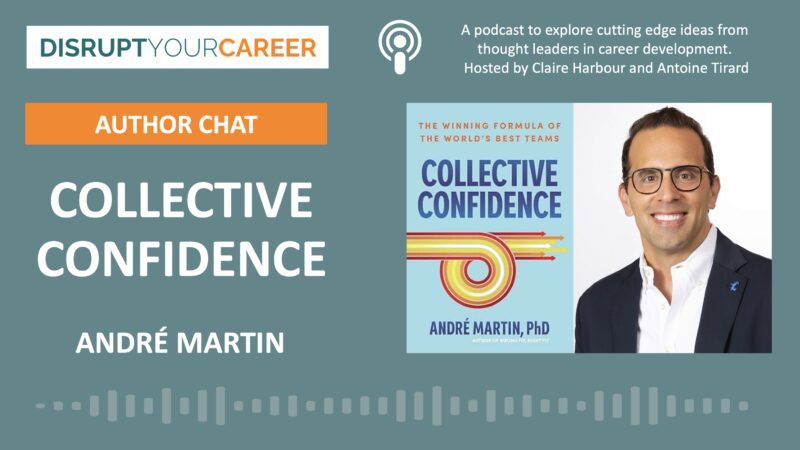
Author Chat: Collective Confidence by André Martin
What separates extraordinary teams from ordinary ones? In his latest book, Collective Confidence, organizational psychologist André Martin explores a powerful but often overlooked factor: the shared belief that a team is capable of achieving something great. Drawing on decades of research, as well as stories from underdog sports teams, submarine crews, creative organizations, and other unlikely high-performing groups, André argues that the collective has become the smallest unit of potential success in a world where increasingly complex challenges cannot be solved alone.
In this edition of Disrupt Your Career Author Chat, we speak with André about what collective confidence really means, why it is different from optimism or positive thinking, and how leaders can build it within their teams. We explore some of the principles that help teams believe in their collective capability and turn that belief into action. An edited version of our conversation with André follows.
What inspired you to write the book? Did you have a specific audience in mind, or did the idea evolve over time?
I think there were three sources of inspiration for this book.
The first goes back 25 years, when this concept was part of my dissertation research. I studied sports teams because I was intrigued by how leadership showed up on a basketball court. One of the concepts that emerged was collective confidence: can leadership create a greater sense of confidence within a team?
More recently, two other things stood out. First, I’ve always been intrigued by teams that shouldn’t succeed. They don’t have the talent or resources, and they aren’t from the big brands. Yet somehow, they succeed. I became fascinated by underdogs and why some teams find a way to win when they shouldn’t.
The final source of inspiration has been the world we live in. It’s lonely and disruptive, and the challenges are incredibly complex. I work with many executive teams that play small. They have all the experience in the world and have been preparing for this moment throughout their careers, yet they still hold back.
I started to wonder whether there was something in this idea of confidence that could help them. That’s really how we got here.
Without giving away too much and spoiling the book, could you share some of the key concepts, methods, and insights it explores? Give us a taste of what readers can expect and take away from it.
I’m happy to. The starting point is: what is collective confidence? What’s the concept? Definitions matter. Words make the world. Collective confidence is not optimism or toxic positivity. Optimism is hope; confidence is rooted in experience. It’s about the extent to which a team believes in its own capability to achieve greatness. The more we can get team members to see the capability they are surrounded by, the more they will have what they need to go and do really hard things.
The whole book is built around this idea. It combines stories from some of the cases I was able to learn about with principles for what leaders can do to build confidence. There are really six. I won’t go through all of them, but I’ll give you the top line. The first is that everyone needs to know they matter. They need to feel seen and valued. That is self-confidence: you can’t have a confident team unless you have confident people.
The second concept, which is one of my favorites, is knowing that my genius, my zone of genius, my superpower, matters here on this team. It’s one thing to be a self-confident individual; it’s another to be surrounded by smart people and ask, “Do I matter here, in this specific moment, with this specific team? Do I have something to offer?” We miss that in a lot of the teams we’re part of.
The other four include borrowing brilliance from other teams that have done things before you. It’s not about TED Talks or giant thought leaders. It’s about exposing your team to another team that is like you in important ways, different in others, and has actually accomplished what you’re trying to do. That way, you know it’s possible. Then there’s engineering first wins. First wins matter, so make sure you’re creating opportunities for first wins in low-stakes environments.
And, last but not least, there’s this idea that we’re better when we learn together and when we make everybody the boss of something. It’s not just about empowerment; everyone should feel that they are the boss of one thing. When you do that, you get so much more discretionary effort.
Those are the main concepts. The book then brings them to life through a series of wonderful, diverse, and really interesting stories of team leaders I went out and talked to.
Could you share one story that particularly struck you, one that deserved its place in the book and has stayed with you?
There are so many, but one that particularly stayed with me came from a very unlikely source: Paul Tryon, a three-time exit entrepreneur who runs a large camp at Burning Man. For anyone who doesn’t know Burning Man, it’s a giant artistic festival where people create a city in the desert in a week, live in it for a week, and then dismantle it and leave no trace.
Paul’s camp, Camp Corny, has 150 volunteers and a 10,000-square-foot camp, all created without any money—just the goodwill of good people. What struck me was Paul’s approach to building a team.
When someone brings him a problem, most leaders would absorb it, take it on, and fix it. His approach is completely different. If someone says, “The camp is covered in trash; we need to do something about it,” Paul says, “You are now the boss of trash.” What he does is take someone who has passion for a problem and turn it back to them: “This is now yours. Do something great with it, and tell me what you need.” I really love that concept.
A second thing he does well is create unlikely duos. He puts people together in small teams so they can learn something they’re passionate about from someone who is an expert. For example, they built a 50-foot unicorn that shot flames from its horn. Paul brought together an engineer who wanted to learn about fire with someone experienced in fire and pyrotechnics who wanted to learn how to build sets. That idea of unlikely duos really struck me.
The last idea is what he calls “slow hangs.” I asked Paul how he gets to know people well enough to put them in places where they can be great and bring out their confidence. Every three weeks, for three hours, they have a slow hang. They open a video, sit together with a cup of something, share stories, talk about what’s happening, and discuss what they could do for the camp. It’s a free-flowing space where people bring all of themselves, and Paul gets to learn who they are and what they can create.
That’s just one story. There are probably 15 or 20 more like it in the book, deliberately diverse: someone who spent 13.5 years leading a submarine underwater, a venture capital firm that thinks differently about talent, a Hollywood production crew that ran Deadliest Catch, and many others. They’re all very different stories, but they show how much confidence really matters.
Is there one final thought you’d like to share with us before we thank you and let you go?
I would just say one thing. The biggest “aha” from all this work is that, in the world we live in, we can no longer solve anything by ourselves. The team becomes the smallest unit of potential success.
We need each other more than ever, yet we seem to be drifting further and further apart. So the hope for this book, more than anything else, is to create that realization: we are better when we are surrounded by people who believe that we can do something great. If we started to approach the world that way, we might see some of the problems we’re facing today begin to disappear.
Order André’s book Collective Confidence
André’s Team & Co website
André’s LinkedIn profile
Sign up
Sign up to receive regular insightful news and advice on managing your career and receive a free gift. Inspiration delivered straight to your Inbox!