
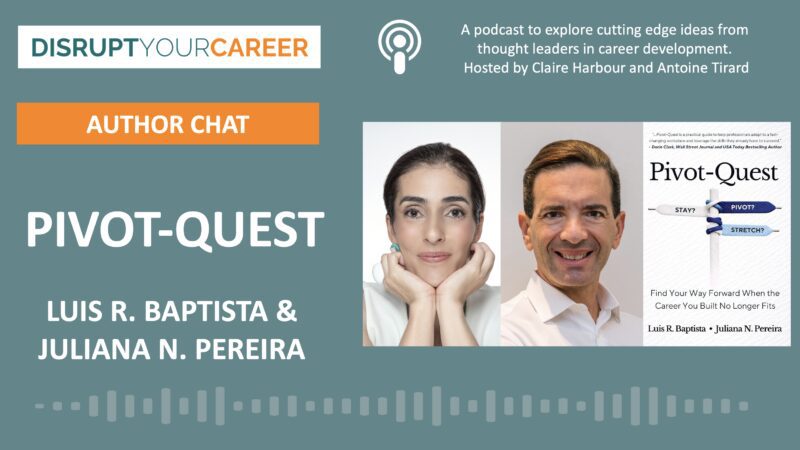
Author Chat: Pivot-Quest by Luis R Baptista and Juliana N Pereira
Your career doesn’t have to follow a straight line. In a world reshaped by AI and changing industries, how can you reinvent yourself with confidence while managing the risks? Luis R. Baptista and Juliana N. Pereira show that successful career pivots start with self-discovery, curiosity, and small steps toward new possibilities.
In this edition of Author Chat, Disrupt Your Career speaks with Luis and Juliana about their book, Pivot-Quest, which draws on more than 100 stories from 25 countries to offer a practical framework for navigating career change. They share lessons from remarkable career journeys and explain how to identify transferable skills, explore new directions, and build your next chapter with purpose. An edited version of our conversation follows.
Disrupt Your Career: How did the two of you come together to create Pivot-Quest? What motivated you to embark on this project?
Juliana: I think two minds work better than one. Luis had already been working on this topic for a year or two. He was thinking about how he could help people navigate career change and was considering creating a platform to support them through that process.
We had met in a previous life. Luis reached out to me and asked if I’d be interested in working on the project, knowing that I’m a serial career pivoter.
For me, the motivation was very personal. Career change is something I’ve experienced throughout my life. It has happened organically, but I know how difficult it can be to navigate constant change.
Three years ago, we could already see where AI was heading and how the future of work was evolving. For me, this project was a way of giving something back.
It also gave us the opportunity to meet so many fascinating people. We spoke with more than 100 people across 25 countries, gathering their nuggets of wisdom. It was an incredible journey, combining our own experiences with research and insights from the experts we interviewed.
Disrupt Your Career: How did you work together to write the book, and what did you learn from the experience?
Luis: We’re going to be very honest: it wasn’t easy at all! We have two very complementary but distinct personalities and ways of working. That’s precisely why I thought this project could be such a good example of how learning to work together can produce the best possible outcome.
Let me give you a couple of examples. We initially divided up the tasks, but when we came together to write the book, it became a constant discussion. Why? Because we’d approached the information from two different angles. We’d spoken to different people, and we brought different perspectives to the table. I think the book is better because we brought those different points of view together.
Here’s another example. I’m obsessed with AI, and I test everything with users or synthetic users. I tested every chapter with both. For your audience, synthetic users are AI representations of people. If a user or a synthetic user made a comment that Juliana disagreed with, she’d tell me. We’d then have a whole discussion about it.
Those discussions are one of the reasons we believe the content is so good.
Disrupt Your Career: What are the key concepts and messages you want readers to take away from the book?
Luis: We built the book around what I describe as a journey. Changing jobs is stressful, and changing careers is even more so. When we started talking to people who felt stuck, we realised we needed to help them adopt a different frame of mind.
We chose the idea of a journey because everybody loves a journey, or at least the idea of travelling. We even tested different concepts, from climbing Everest to going on a treasure hunt in the middle of the ocean!
Eventually, we developed what we call the four steps. They’re not strictly linear; they’re interconnected.
First, you discover who you are. This means undertaking the self-analysis that we often neglect.
Second, you define your options. From all the possibilities available, you identify which ones you want to pursue. This means prototyping, testing, and finding out more about them.
Third, you shape your new story.
Finally, you go out and test it.
Although the book presents these as four steps, the process is much more interconnected in reality. You move from one step to another and sometimes return to an earlier one.
The framework helps you understand what you need to do to make your career pivot successful. It might even lead you back to your original job, but with a renewed sense of appreciation: “I’ve experimented with other possibilities, and I think I’m happy where I am.”
Another important contribution came from Juliana. Throughout this journey, we encountered many topics related to personal branding, curiosity, and finances. Juliana suggested including conversations with experts on each of these subjects.
We reached out to more than 30 experts and created what we call the Cheat Code, which appears at the back of the book. It brings together stories from experts and short exercises.
Disrupt Your Career: Could you share a story from the book that illustrates what a career pivot can look like?
Juliana: There are so many stories, but two always stand out in my mind. The first is about someone who had spent his entire career in the legal profession.
One interesting finding emerged as we spoke to more and more people: a career change or reinvention isn’t just a career event; it’s a life event. Life happens first, and the career follows. Many people realised they’d changed careers because something significant had happened in their lives. For some, it was a dramatic event, such as a health crisis. The person I’m thinking of had a brain tumour in his forties, which made him reassess his entire life.
He had a successful legal practice and could have continued working as a lawyer, with the full support of his wife. But the experience prompted him to pursue something he’d always been curious about: coaching. He’d experienced coaching himself and wanted to move into that field.
Based in the Netherlands, he approached exploring this new profession with the analytical mindset you might expect from someone with a legal background. He started by asking how many coaches there were, how many were certified, and how many held a particular certification. That could easily have discouraged him, but he decided to keep going.
Like many people making a career change, he experienced imposter syndrome. How would he find clients? Where would he start? Did he have transferable skills? How could he establish credibility without a professional background in coaching?
What was remarkable was that he eventually recognised how much his legal experience had prepared him for coaching. Think about it: when you go to a lawyer, you need to trust them and confide in them. He’d spent years developing precisely those skills, but he hadn’t recognised their value in a different professional context. When he began speaking to people and attracting his first clients, he discovered that trust was something he could build on immediately.
His story illustrates how easily we put labels on ourselves and overlook the qualities and transferable skills that lie behind them.
Disrupt Your Career: And what’s the second story that stands out for you?
Juliana: The second story is about a woman named Eileen. She’s 82 years old and has made 16 career pivots throughout her life.
I remember speaking with her and seeing her enormous smile. She told me that her father had once said that if she learned to type on a typewriter, she would always have a job. She laughed because, of course, typewriters have become obsolete. But the underlying message was still relevant: her father’s advice was really about learning. If you remain curious and are willing to acquire new skills, you’ll always be able to adapt to the world of work.
Eileen’s career is extraordinary. After the Second World War, she worked as a cook on a ranch. She went on to open her own organic food store, at a time when that was hardly commonplace. She later taught at Harvard and created the learning and development department at Deloitte. It’s a fascinating story!
When you look at all 16 of her career pivots, you might wonder what connects them. That’s something we explore in the book. We often describe ourselves through our job titles, which can make our careers seem disconnected when viewed from the outside. But when you connect the dots, you can identify a common thread. For Eileen, that thread was learning.
These two stories illustrate some fundamental themes in the book. The first is the importance of self-discovery: understanding who you are, which values matter to you, and what other people trust you to do. This helps you recognise the value you bring and identify your common thread. From there, you can articulate your transferable skills and understand how they can be applied in different contexts.
A career pivot doesn’t necessarily have to be a huge, bold, courageous leap. It’s much more about being curious and building momentum, one step at a time. It might start with one coffee, one email, or one small action that leads to the next.
Learn more about and order Luis and Juliana’s book Pivot-Quest
Luis’ LinkedIn Profile
Juliana’s LinkedIn Profile
Sign up
Sign up to receive regular insightful news and advice on managing your career and receive a free gift. Inspiration delivered straight to your Inbox!