
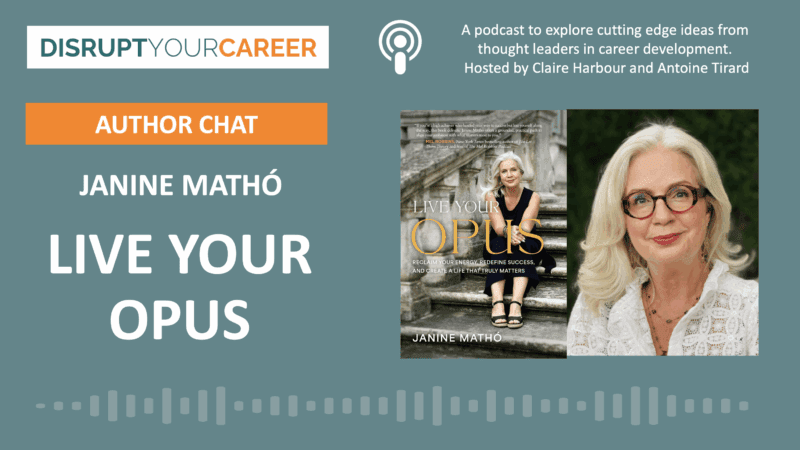
Author Chat: Live Your Opus by Janine Mathó
You’ve built a life that looks successful, but inside, something’s stirring. You’ve done everything “right,” yet you find yourself wondering: Is this it? What now? In Live Your Opus: Reclaim Your Energy, Redefine Success, and Create a Life That Truly Matters, Janine Mathó writes for ambitious, high-achieving people who feel depleted, disconnected, or misaligned, and who sense that the version of success they followed no longer fits.
In this edition of Author Chat, Disrupt Your Career speaks with Janine about her book, reclaiming energy, redefining success, and choosing a life that truly fits. She shares the core ideas behind Live Your Opus, that your life is your opus and that you are your greatest work, and offers a practical path for creating sustainable, meaningful success. An edited version of our conversation with Janine follows.
Let’s start with the origin question: why did you write this book? And as importantly, how did you write it?
I wrote Live Your Opus for the ambitious person and the high achiever who’s done everything “right” and still feels like something’s missing. So people who maybe they’ve got the degree, they’ve got the job, they’ve got next job, the promotion, the paycheck, the house, the car, whatever it is that “success” is for them, and they’re still standing there going: “Is this it?” I wanted to give talented people permission to choose themselves again, to choose a life that actually fits. I know what it’s like to feel like that because I lived it. I had the roles, I had the titles, I had the respect, but underneath of it, I was exhausted, I was depleted, I was disconnected. I would say I was high functioning but not flourishing. As you know, my own burnout in 2019, which was at the same time as my mother was killed in a car crash, forced a pause. In that pause, so many questions surfaced: Who am I without my title and my affiliation? What matters most to me, really? There was one question that stuck with me and still does, which is a long question, but it’s: How can ambitious people attain healthy, meaningful success that lasts without losing themselves or what matters most to them along the way? That question has become a quest for me.
With the book, I started with the data. I poured over data from every Future of Work report and every study on employee engagement or the state of the workplace that I could find. I quickly learned that burnout and the issues that I was facing with chronic stress and disconnection and this sense of not having enough meaning, weren’t unique to me. This is an epidemic. Some statistics that stick with me – and I repeat these all the time and people are always shocked – that seven in 10 people are living with symptoms of chronic stress or burnout. I think that’s frightening. 45% of leaders report feeling overwhelmed most of the time. I think that number is probably a lot higher, actually, from the pressure. On top of that, you’ve got people staying in jobs that drain them and then don’t feel meaningful, so meaning feels elusive. These trends reflect a collective depletion of energy, morale, and connection that in the book, I call an ‘emotional recession’. An emotional recession, like an economic one, signals widespread and unsustainable depletion, not of money, but energy, morale, and human connection. It’s not just burnout. It’s this collective sense of detachment and exhaustion from ourselves, one another, our world, and the work we do. The energy that we need to fuel innovation, collaboration, and growth is running dangerously low. I would say burnout, disconnection, and mental health struggles, and the search for meaning, acting like rolling blackouts across industries.
For this book, I interviewed over 200 professionals, execs, educators, founders, people who were navigating reinvention, life or career inflection points, career pivots. I wanted to use their experience as a sounding board to better understand the data that I was seeing, but also to understand what worked for them or didn’t in turning things around. Because, of course, while I was interviewing people, I was going through my own burnout recovery and asking myself the same questions that maybe they had asked themselves. With my background, I brought everything I learned in my 25 years in learning, leadership and the future of work, and I dove deep into new areas, new to me: neuroscience, positive psychology, ancient wisdom traditions and stories. I built a practical, soluble path back to yourself.
At first, the way that I shared in the book didn’t look like that. At first, it was just for me. Eventually, it was refined for my clients and the three programs that I led, and then now codified in Live Your Opus. Maybe I should also be clear because sometimes people hear my story and they think, “Oh, it’s a book about burnout”. I want to say it’s not a book about burnout, though a lot of people arrive here from that place, but this is a book about what happens after you realize that the path that you were told would lead to fulfillment, or the path that you chose because you thought it would lead to fulfillment doesn’t. You see so many of us follow this version of success that we didn’t author. So the book is about reclaiming authorship, about choosing a definition of success that’s meaningful, that’s alive, that’s sustainable. And then, of course, there’s the real work in the book, which is figuring out how to get out of your own way so that you can actually live that life.
In the end, it’s a book for everyone, relevant at any age…
… Maybe also permission, because I think the hard part is once you’ve forged your way in life, you think, “Well, I can’t turn around and change it. Not in the big ways”. Actually, sometimes you can.
Tell us about some of the key concepts and messages in the book.
At the basic level, this book sits on two core truths – truths that I think once people see them, can change everything, at least from the get-go. The first is that your life is your opus. An opus is a beautiful body of work, a masterpiece, and your life is this living, breathing body of work that you get to compose, and only you get to compose it. It’s not something you have to chase or prove. It’s something you shape and you feel. Then the second is that you, not your job, not your resume, not your achievements, not your marriage, not your children, you are your greatest work. With these two basic mindset shifts – your life is your opus and you are your greatest work – it’s about building a life and career from the inside out. Of course, the book includes frameworks and a path to begin living in this new way, to take these mindsets on the road, so to speak. The Opus 8 Energy System is there, and that’s a method that helps people reconnect with their physical, mental, emotional, and spiritual energy because sustainable success needs fuel, not just goals and action.
Then there’s the 12-Week Journey, which is the essence of the book, which helps the reader move through four stages: Connect, Dream, Compose, and Embark, and helps them think about and reconnect with themselves, realign their work and life, and start to actually live from that place of alignment, not just think about it. It’s a very action-oriented journey. It’s almost like you were in the room with me or another coach, because I do believe that everyone should have access to these kinds of tools. The book helps people break free from what drives most of us, thought loops and expectations that we never chose, definitions of success handed down by parents or systems or cultures. We explore everything and anything that gets in the way of breaking free from that. We explore fear of other people’s opinions, the upper limit problem, the zone of genius, the science of mindset and neuroplasticity, all of it, but within those four stages of the journey, Connect, Dream, Compose, and Embark, dealing with the right concepts at the right time in the stage so that we can break free and build something real for us.
If I understand correctly, there will also be a workbook, so the book doesn’t just stay on the page but gives readers tools to experiment with and work on.
Yes. Thanks for the reminder. The book itself has many exercises in it as it’s moving people through that journey. But the workbook adds many more because we all come at this work with our own experiences and our own ways of learning. The workbook is a key piece for that.
The book includes many stories from your coaching work. Could you share some that captures a pattern you see again and again?
This book is full of real-life vignettes, not just to illustrate, but sometimes to validate, because when you coach the way that you do and I you, you begin to see patterns, and you see how many talented, high-achieving, ambitious people get in their own way, not because something’s wrong with them, but because we’re running scripts many times that we didn’t write. I included dozens of stories that reflect the patterns, moments when clients or folks who shared their stories with me hit walls or chose reinvention, or faced their own resistance.
We can talk about André, an executive who I like to say mistook speed for leadership, so a very highly respected senior executive – the kind of leader who energized a room and delivered results under pressure and built his reputation on decisiveness and speed, a person constantly in motion, a bit of force of nature. But as his career advanced, that very way of being, especially the very habit that once served him, this relentless pace that he was known for, that became his constraint.
His team struggled to keep up. Execution started to falter, trust began to erode. He had essentially outgrown the leadership style that got him there. I see this a lot: sometimes as leaders, we forget If we are working from early morning to late at night plus weekends and expecting our team to do the same, we are asking everyone. André was asking everyone to work at a relentless pace, and that only works for so long until it doesn’t. For him, the shift came from fatigue. Just one morning, he sat down in a meeting and realized he had nothing left to give. It was that simple. This isn’t working anymore. I think that was important that he noticed it, first of all, because it’s this moment when he sought out coaching, but he also began to intentionally evolve his leadership style. Really thinking about, “Okay, the way I’ve been working isn’t working anymore. What do I want this to look like? How do I want to lead? How do I want people to feel when they work for me? How do I want to feel when I’m doing this work?” He reframed his values. He made presence a key value.
Before, I think output and productivity would have been more the value. This is very common, obviously. He had to find his rhythm. He made managing his energy a leadership competency. Rather than thinking, “Well, if I slow down, I’m going to be less important, or If I slow down, I won’t get as much done”. He realized that actually he had to schedule in the time to manage your own energy, both to get in physical exercise and movement, to get in thinking time, to get in time with people you want to connect with. The result was a much more sustainable type of leader. The team was more sustainable. The team felt more capable. They were capable. They were just tired. A renewed sense, I think, of integrity. He slowed down to lead better, actually, which I think is hard to do when you’re at a very senior level. This way of working has been working for you for a long time.
Exactly. Early in our careers, productivity serves us well—but it doesn’t always work when you’re leading a 10,000-person organization. That’s a great story.
I’ll share another story. Because I work with a lot of founders, I can tell a very short story about a woman named Vanessa, who was building a purpose-driven business. When she left her full-time job and she came into this founder role for herself, she expected to be spending time on the things that, “mattered”. For her, that was strategy, client development, getting her product and services organized and pitching them. But what she encountered was much more personal. She encountered her own resistance. She encountered procrastination, perfectionism, fear of rejection, you name it. She faced it and she said to me, I thought I’d be out there pitching clients, but here I was sitting at home working on fear. I was learning to believe in myself still, even though I had all of this expertise. I see this happens a lot when you leave an organization and a leadership role and you move into your own work, sometimes you feel like, “Actually, do I know how to do this?” Even though you have all of this expertise, you feel like a beginner again. In the end, because she focused on mastering the one most important thing in the business, which was herself, she ended up growing her business.
I share it because I see this so much in founders. They’re not considering the work that they need to do on themselves to become the person who builds the company that they’re trying to develop. You’re starting in one place and you say, “Okay, I want to build a company that does this”, but you don’t have to become the person who does that. There’s a gap and there’s growth that needs to happen.
Thank you, Janine.
To listen to this Author Chat podcast episode
Order Janine’s book Live Your Opus
Janine’s website
Janine’s LinkedIn profile
I
Sign up
Sign up to receive regular insightful news and advice on managing your career and receive a free gift. Inspiration delivered straight to your Inbox!